Building a solar repeater to hang in a tree
Our rooftop repeater in Woburn talks to the wider Boston mesh, but only one neighbouring repeater hears it reliably. The hills around town are where a radio does its best work, and most of them are covered in trees. So we are building a small, sealed, battery-and-panel repeater that can be hauled up into a tree on a rope and lowered again for service. This is the plan, where it could go, and what it is made of.
The plan: bench first, tree later
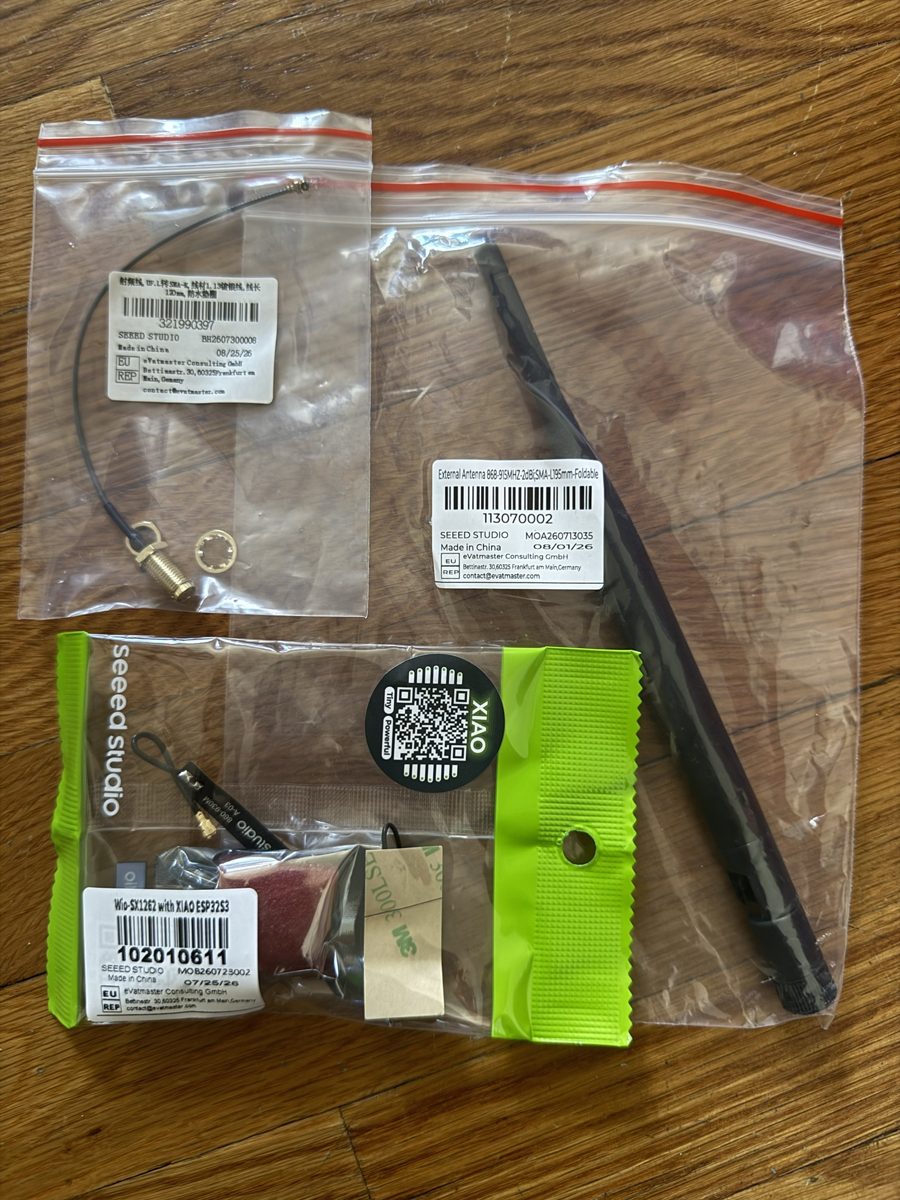
- On the bench. A Seeed XIAO ESP32-S3 + Wio-SX1262 kit has arrived. It runs MeshCore repeater firmware with the same settings as our rooftop (below), and is where we practise the wiring, firmware and settings.
- From the ground. Prove it links back to the rooftop before anything goes up a tree.
- Into the tree. The board that stays up through the winter is the XIAO nRF52840 + Wio-SX1262 kit: the same size and radio, about a third of the power.
Parts and what each one does
| Part | Role |
|---|---|
| Seeed XIAO nRF52840 + Wio-SX1262 kit | The radio in the tree: Bluetooth-programmable board plus the SX1262 LoRa radio. Low power, so solar can keep up in winter. |
| Seeed XIAO ESP32-S3 + Wio-SX1262 kit | The bench board: same footprint and radio, three times the power. For testing, fall hangs and spares. |
| 2 × Samsung 35E protected 18650, 3500 mAh | The battery, in parallel: about 25 Wh. Protected cells cut off before they over-discharge. |
| Adafruit BQ24074 solar/USB charger | Charges the cells from the panels and powers the board from its OUT pin. Handles panel and battery at once. |
| 10K 3950 NTC thermistor | Taped to a cell and wired to the charger's TS pin: no charging below 0 °C, which lithium cells need. |
| 3 small solar panels, one per face | Options: 6 V panels (best match for the BQ24074), Uxcell 5 V 1.15 W (100.8 × 82.5 mm), or the 110 × 60 mm 5 V 1 W epoxy panels the hanging designs use. |
| 3 × Schottky diode (1N5817/1N5819) | One per panel, so a shaded panel can't drain the sunny ones. |
| U.FL-to-SMA bulkhead cable, 2 dBi SMA antenna | Carries the radio through the housing wall with a waterproof washer; the antenna hangs below. A 4–6 dBi antenna can come later. |
| M12 breather vent | Lets the sealed housing breathe so temperature swings don't pull in damp air. |
| 2" Schedule 40 PVC pipe, two cleanout adapters and threaded plugs | The sealed body. Plugs unscrew for service; the bottom one carries the SMA and vent, the top one a stainless eyebolt. |
| PG7 cable gland | Where the three panel leads enter the pipe. |
| Printed PETG parts | Two panel collars, corner clips, the inner sled for cells, charger and board, a drill guide and an antenna drip shield. |
| Ball-bearing swivel, arborist throw weight and line | Gets it over a branch and lets it turn in the wind without twisting the line; a UV-resistant cord carries the weight. |
Wiring
- Panels → diodes → charger. Each panel goes through its own Schottky diode, and the three join at the BQ24074's solar input.
- Charger → cells. The two 18650s, in parallel, connect to the charger's battery terminal, with the NTC thermistor on a cell wired to TS.
- Charger OUT → board. The radio board is powered from the charger's OUT pin.
- One charger per pack. Never also connect the cells to the XIAO's own battery pads: two chargers fighting over one pack is how cells get damaged.
Power budget
| Board | Draw | Per day | December, 3 panels |
|---|---|---|---|
| XIAO ESP32-S3 (bench) | ≈ 45 mA | ≈ 4.0 Wh | ≈ 2–3 Wh made: runs short in a cloudy week, goes dark, recovers on its own |
| XIAO nRF52840 (tree) | ≈ 15 mA | ≈ 1.3 Wh | ≈ 2–3 Wh made: about twice what it needs |
Two 35E cells hold about 25 Wh: two to three weeks of the nRF52840 with no sun, even allowing for cold. Panels tilt steeply (about 55–60° from flat) so snow slides off and the low winter sun lands square. These are estimates from our notes; we will measure the real draw on the bench.
Housing options
PVC tube with printed collars (first build). The 2" pipe and screw-in cleanout plugs make the seal, so there is no gasket to design; two printed collars hold the three panels in a triangle around it, and the electronics sled slides out when a plug is unscrewed. The trade-off is weight, and the pipe gets a light, matte paint against UV and summer heat.
Printed three-panel body. Lighter, and already proven up a New England tree: remix The Corebell or the Hanging Solar Node with its SMA base, adding a tray for the XIAO kit, the BQ24074 and two 18650s, plus a vent (none of these designs has one yet). The seal then depends on print quality.
Treepeater. Treepeater V4 already holds two 18650s and three 60 × 110 mm panels with a diode on each, tilted for the winter sun; it needs a new mount for the XIAO kit.
MeshCore repeater settings
| Radio | 910.525 MHz · 62.5 kHz bandwidth · SF7 · CR5 (the Boston Mesh settings) |
| Regions | bos, east, northeast, ma, each added with region put and region allowf, then region save (regions don't inherit) |
| Adverts | Flood advert every 47–48 hours; local advert every 240 minutes |
| Power saving | powersaving on for the solar board |
| Admin | A remote-admin password, proven from the MeshCore app before it goes up; firmware 1.16 or newer, updated over Bluetooth in the tree |
Where it could go
We ran the terrain between each candidate spot, the rooftop and the repeaters around it, using bare-earth elevation data (trees and buildings are not in the model). A path is clear when most of the radio beam passes above the ground, marginal when it is within a few metres, and blocked otherwise. Places near homes are shown approximately.
Horn Pond Mountain is the spot we have already tried: a small radio in a tree there reached North Cambridge directly about half the time (the field test). It has the only clear paths to the east. A hill in central Woburn is clear to the busiest repeater to the north-west. A pine in Lynnfield would cover a stretch with no repeater within three miles today.
| From | To | Distance | Terrain |
|---|---|---|---|
| Our rooftop repeater | A wooded hill in west Woburn | 1 mi | marginal |
| A hill in central Woburn | A wooded hill in west Woburn | 1 mi | marginal |
| Our rooftop repeater | Horn Pond Mountain | 2 mi | clear |
| A wooded hill in west Woburn | Horn Pond Mountain | 1.5 mi | marginal |
| Our rooftop repeater | TEMP-MNK-1 | 2 mi | clear |
| Our rooftop repeater | K1UHV_Solar | 3 mi | blocked |
| Our rooftop repeater | Stoneham-RPT1 | 2 mi | blocked |
| A hill in central Woburn | TEMP-MNK-1 | 2 mi | clear |
| A hill in central Woburn | K1UHV_Solar | 3 mi | marginal |
| A hill in central Woburn | Stoneham-RPT1 | 2 mi | blocked |
| A wooded hill in west Woburn | TEMP-MNK-1 | 1.5 mi | clear |
| A wooded hill in west Woburn | K1UHV_Solar | 4 mi | marginal |
| A wooded hill in west Woburn | Stoneham-RPT1 | 3 mi | blocked |
| Horn Pond Mountain | TEMP-MNK-1 | 3.2 mi | marginal |
| Horn Pond Mountain | K1UHV_Solar | 3.7 mi | clear |
| Horn Pond Mountain | Stoneham-RPT1 | 2.7 mi | clear |
A few of the paths, side on. Solid line: the straight radio path; dashed: the bottom of the part of the beam that has to stay clear.
Real traffic beats the model: our rooftop does reach the Stoneham repeater in practice, even though bare terrain says blocked.
Low-key, not hidden
Olive, tan or brown PETG or matte plastic paint; never paint over the panels; no metallic paint near the antenna; mid tones rather than black so the cells don't cook in summer; brown cord tied off against the trunk; and a small label saying what it is and who to contact.
Designs we are learning from
Several people have already built hanging solar nodes and shared the files. Thank you to their makers:
- The Corebell (Printables, CC BY-NC-SA): three panels around a printed body, proven up a New England tree through rain and snow.
- Hanging Solar Node and its antenna-connector base (Printables, CC BY-NC-SA).
- LoRa SolarNode v2.0 (Printables, public domain): the best lid seal we found.
- Mounting case for the XIAO ESP32-S3 + Wio-SX1262 kit (Printables, CC BY-NC-SA): our bench case.
- Treepeater V4 (MakerWorld, CC BY-NC-SA): tilted panels for the low winter sun.
We will post again when it is on the bench, and again when it is in a tree.